Monday, October 19, 2020

‘Left’ and ‘Right’ in Israeli Politics - Meaningless?

For revolutionary Leon Trotsky, politics was about principles and ideas: permanent revolution, opposition to socialism in one country, internal party democracy. For Josef Stalin, the Soviet leader, who sent his NKVD to murder Trotsky with an ice-ax on August 20, 1940, politics was mostly about the quest for personal power. (*)

Mercifully, by 2015 when Binyamin Netanyahu ousted the last of the followers of Ze'ev Jabotinsky from Likud, no ice-ax, God forbid, was involved. 

The Prime Minister needed to solidify control of the party. 

Having principled naysayers piping up about liberalism, tolerance, the rule of law, or setting personal examples of probity was just not on.

The 1949 First Knesset was comprised mostly of ideological parties very much concerned with principles and ideas: Mapai (including Hapo’el Hatza’ir and Ahdut Ha’avoda) led by David Ben-Gurion; Mapam (Soviet-leaning socialist); Religious Bloc (Mizrahi, Hapo’el Ha’Mizrahi, Agudat Yisrael, and Po’alei Agudat Yisrael ); Herut (Jabotinsky-oriented, liberal nationalist, Menachem Begin-led); General Zionists (liberal-capitalist); Progressives (European-style liberal); Sephardic; Communist (pro-Soviet, mixed Arab-Jewish); Arab (Mapai-affiliated Arab list); Fighters’ List (Lehi-affiliated); Women’s International Zionist Organization, and Yemenite Party

I do not much mourn the withering of dogmatic Left-right ideological parties from Israel’s scene. The disappearance of principles and rectitude that had usually gone hand-in-hand with the parties and personalities of yesteryear is what I lament. These have been replaced today by tribal, religious, or ethnic entities sometimes led by parochial, not-yet-indicted leaders (though some were previously convicted or are presently charged with graft).

Nowadays, Israel’s main parties and players are barely distinguishable on issues of principle. Sometimes it is for the good that they mainly agree on the big picture – the Jewish ethos of the state, government intervention in the economy, welfare safety nets, and the intractability of our conflict with the Palestinian Arabs. Sometimes the consensus is unhelpful as when they mostly disregard Israel’s income disparity problem.

Instead, the main cleavages are tribal, religious, and cultural. 

These are important issues, don’t get me wrong. The demands by the ultra-Orthodox-leaning national religious (חרד״ל) and the non- or anti-Zionist ultra-Orthodox (חֲרֵדִים) to turn Israel into a demi-theocratic state could well tear the country asunder. 

However, the problems don’t lend themselves neatly to placement on the standard left-right political spectrum. Some theocrats are dovish on war and peace. Most are proponents of big government and favor a redistribution of income.

In the March 2020 elections, about 48 percent of the combined vote went to rabble-rousing Likud, ultra-Orthodox Shas and UTJ, and Yamina, which would like to see a Knesset majority empowered to overrule Supreme Court decisions. A terrible idea. 

The largely illiberal Arab parties (pro-PLO or Islamist) garnered nearly 13 percent. Roughly six percent went to the small-minded Russian-speakers’ Yisroel Beitenu (led by Netanyahu's former righthand man and now unwavering enemy Avigdor Leiberman), and the mostly secular, mindlessly dovish Labor-Meretz.

That left a mere 27 percent of the electorate to vote for the new (and now probably moribund) centrist Blue & White Party led by Benny Ganz.

Israel’s political system encourages bespoke parties. For example, Degel Hatorah, a component of the aforementioned UJC, claims to look after the interests of “Lithuanian” Ashkenazi Haredim. Aguda, another component of UJC, saves a seat for Hassidim who tuck their trousers into their socks. 

The electoral system offers citizens an incentive to cast ballots for custom-made parties with no mainstream appeal because they can “win.” Just 3.25 percent of the proportional vote can catapult a flash-in-the-pan or narrow interest party into the 120-seat Knesset. In a country where no party in history has won a Knesset majority, even flash-in-the-pan parties hold sway in forming a government.

Broad-based centrist parties that entice politicians to embrace moderation and pull voters from the margins toward a common purpose do indeed come and go. These “third-way” parties (melding left and right and a dose of reform-minded civic responsibility) invariably implode because the system provides little incentive in the long term for them to hold together.

The chances are slight for political reform that would move Israel away from pure proportional representation, disincentivize tribalism, and pump the breaks on our drift in the direction of tyranny-by-majority-rule.

Between that First Knesset in 1949 and our 2020 23rd Knesset, principle and ideology faded like a masterpiece exposed to the sun. Prime Ministers and their families used to live in modest apartments and make their breakfasts. Golda Meir might guiltily ask friends to bring her a carton of Marlboro’s from abroad. 

Today, despite having a chef on staff, the Netanyahu’s ordered $96,000 worth of catered meals to impress foreign dignitaries. The taxpayers picked up the family’s $2,700-a-year tab for ice cream. The PM received more than $280,000 worth of cigars from Hollywood producer Arnon Milchan. And so on and so on.

The fading of principles happened as Ben-Gurion’s Mapai incarnated in today’s Labor Party, which is down to three seats. Mapai in its time was corrupt but in a political sense in order to maintain a monopoly of power.

Ehud Barak, one of modern Labor's former leaders who started off as a kibbutznik, is now worth over $30 million. Having capitulated and joined Netanyahu’s current government, polls suggest Labor, which played a pivotal role in founding the state, may disappear in the next election.

Mapam’s successor party is Meretz (dovish and now social democratic) with three seats. 

The Religious Bloc has morphed and expanded. Its workers’ factions, Hapo’el Hamizrahi and Po’alei Agudat Yisrael, have gone extinct (together with the idea that the really frum should work for a living and that only outstanding Talmudic scholars should be exempt from IDF service). 

Mizrahi, which once represented the knitted kipa politically moderate religious Zionists, is also extinct. 

Agudat Yisrael, though, has thrived as the party of the non-Zionist Hassidic Haredi camp. It runs on a ticket with the non-Zionist Lithuanians under the United Torah Judaism (UTJ) banner and has seven seats.

While the Sephardic and Yemenite parties have disappeared, their successor party is the non-Zionist, ultra-Orthodox Shas (most of its Talmudic students do no army service) with nine seats in the current Knesset.

Yemina, which wants to render ineffectual the independent liberal-leaning judiciary, has five seats in the current Knesset. It is an amalgamation of several Orthodox parties and reflects settler-hardel ideology. However, curiously as this may seem, its leaders Naftali Bennett and Ayelet Shaked, are malleable on religious issues and adept at rebranding. Their long-term goal is to replace Bennett’s former mentor, now arch-enemy Netanyahu as prime minister using whatever party vehicle is expedient.
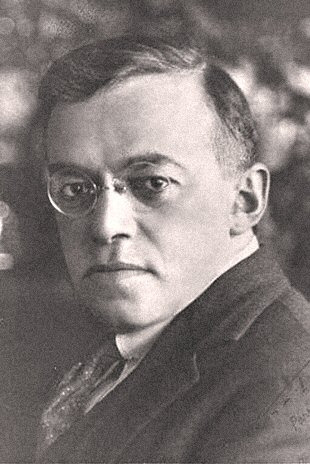
Herut’s successor party is Likud; portraits of Jabotinsky and Menachem Begin still hang at party headquarters. However, Netanyahu-led Likud with 36 seats is purged of Jabotinsky/Begin liberals and anyone else who might have been considered an immediate political threat to the leader. 

Likud stands for whatever Netanyahu wants. As the longest-serving prime minister, he defines Likud; and he epitomizes brand Israel to the world for better or worse.

Under multiple indictments for corruption Lord Acton’s line, “Power tends to corrupt, and absolute power corrupts absolutely,” expresses what Bibi has become. 

Alongside his strategic brilliance, diplomatic ingenuity, and intellectual depth, he is duplicitous to the core, both for and against a Palestinian state. For and against caving-in to Hamas demands. For and against a complete COVID-19 lockdown. For and against extending Israeli sovereignty to Judea and Samaria. His foremost goal is to buy one day at a time for himself politically.

The metaphorical successors of the 1949 General Zionists and Progressive Party are Blue & White and Yesh Atid led by Benny Ganz and Yair Lapid, respectively.

In the last election, Yesh Atid ran with Blue & White. With 14 seats, Ganz broke his promise to the electorate and joined Netanyahu’s government, Lapid stayed out with his 17 seats. Lapid’s central tenet, beyond steadfastly seeking Netanyahu’s defeat, is opposition to theocracy. His voters tend to be middle class and middle of the road. Beyond that, the former TV talk show host is, like Ganz, politically pliable.

Blue & White serves as an example par excellence of a centrist party that emerged before an election only to disappoint and (if history is a guide) eventually to disappear.  

Like I said, I don’t miss the parties of yesteryear with their unbending allegiance to the Workers, or Greater Israel, or the Comintern. That said, whatever else they are, today’s ideologically promiscuous and principle-compromised parties can’t usefully be slotted into any left-right political continuum.

Left and right don’t mean much in the Israeli political setting.

 ------------------------------    

See too:

What does it even mean to be a ‘liberal’ or ‘conservative’?

(*)  See Dmitri Volhogonov's TROTSKY: THE ETERNAL REVOLUTIONARY:

"Trotsky's individuality lay primarily in his obsession with the Idea. For him the Idea was the equivalent of a philosophical temple, in which everything created within it belonged to eternity. For him the greatest spiritual luxury consisted in the ability to think and reflect freely..." (page 488)

To be fair, according to Volhogonov,  Stalin appropriated some of Trotsky's ideas making them his own. And Trotsky along with Lenin set up the system (including the bureaucracy) that Stalin exploited in his genocidal reign. Ideas aside, the men -- both profoundly arrogant -- hated each other.


Monday, October 05, 2020

Addicted to the News

News seized my attention in elementary school and never let go. The most fun I had in the classroom was when our seventh-grade social studies teacher handed out a weekly magazine called Current Events. How that innocuous periodical breached the ramparts of our insular ultra-Orthodox Yiddish-oriented yeshiva, I do not know.

In contrast to most of my classmates, my mother read a tabloid newspaper regularly, and we had a television.

By the time I was finishing high-school (at a somewhat less inward-looking yeshiva), I had begun picking up the New York Times at the newsstand. That sufficed through college. When I started graduate school, I had discovered kiosks that sold out-of-town newspapers and started getting The Washington Post. At some point, a newspaper home delivery company belatedly began servicing our Lower East Side neighborhood. I “took” the Times, Washington Post, and either the Daily News or the New York Post.

The mailman delivered The Christian Science Monitor (because John K. Cooley, based in Beirut, provided coverage of Palestinian Arab affairs available nowhere else). On Fridays, the weeklies arrived, such as the Village Voice, The New York Jewish Week, The Washington Jewish Week, and the Forward (between 1983-2000 a balanced must-read).

Separately, I’d buy the pricey Economist weekly and the Manchester Guardian (which carried Le Monde), both printed on thin airmail newsprint.

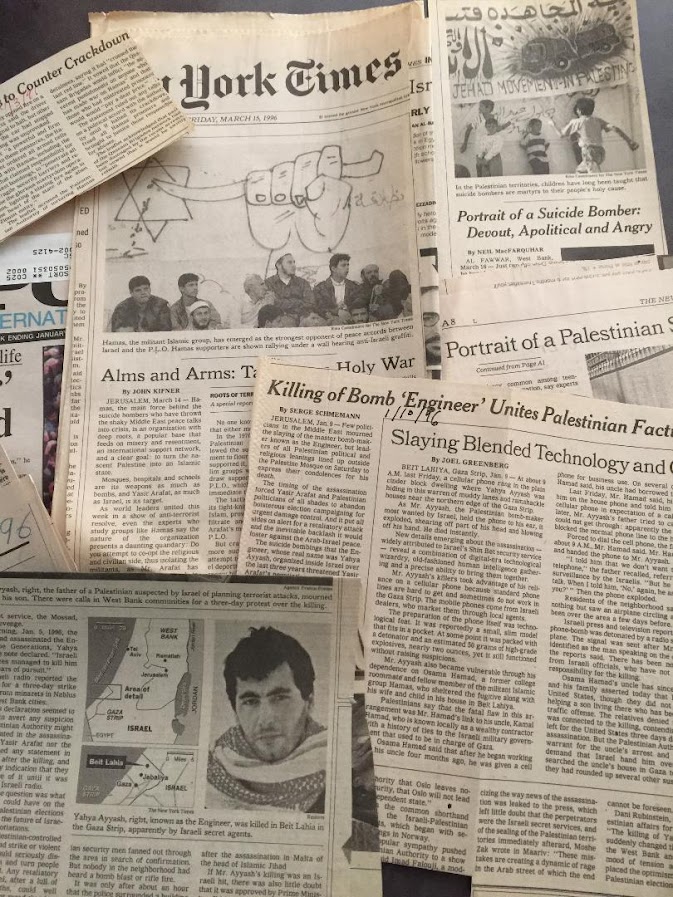
Clipping file 'Hamas' 1996


Through involvement in Zionist politics, I met NR (Ricky) Greenfield, a Wall Street guy who went on to buy the Connecticut Jewish Ledger, who subscribed to a slew of newspapers, magazines, and Jewish periodicals. Ricky would send out a weekly packet of photocopied opinion clippings, and I felt privileged to get on his mailing list. In the pre-Internet age, getting Ricky’s clippings helped me know what pundits were saying.

Still, I had a craving for more. I was taking the JTA Daily News Bulletin (awfully expensive to private subscribers like me but, in those days, a unique fair-minded resource) and Beijing Review, the airmail edition of The Jerusalem Post – and who remembers what else. The Beijing Review weekly because I was researching China’s policy toward the Arab-Israel conflict. Eventually, I built clipping files (anti-Semitism to Zionism) something newspapers and organizations did on a bigger and better scale in the pre-Internet age.

The written word didn’t satiate. So, I tuned into Kol Israel over shortwave and watched (what is today) the PBS Newshour and C-SPAN (which transmitted congressional proceedings). When I could, I also listened to Morning Edition and All Things Considered on NPR. 

The news and views that I was hooked on were explicitly about politics. Fortunately, it was a compulsion I could feed legally without having to mug anyone.

I knew there was no way to maintain my expensive habit once I gave up my job and moved to Israel. I did arrange for the New York Times Book Review and a handful of other subscriptions to be forwarded to me via my Israeli family, knowing I probably would not renew them.

Fortunately, by 1997 the Internet had taken off, and soon I was reading online newspaper websites. I’d still buy the International Herald Tribune (in those days a joint endeavor of the Washington Post and The New York Times), which arrived in Israel from Paris within a day or so of publication. When I started working at The Jerusalem Post, I began to read the news in Hebrew laboriously. The Post used to print several Haredi newspapers, and I began perusing those to get a sense of their jargon and sensibilities.

My obsession with current events was undiminished, but it narrowed parochially to Israel (with an eye on the Old Country and perhaps Britain). Now, I faithfully watched the Hebrew news on television, switching between the channels.

However, my world broadened again when I began working for a US news outlet, and I had to refamiliarize myself with the personalities and players.

As I soaked-up news and views, it dawned on me that people around me not only did not take in much news many conscientiously avoided knowing what was going on. Israelis no longer reflexively stopped in their tracks for the hourly radio news bulletin.

Nowadays, my impression is that Israelis do not routinely watch the nightly news broadcasts on TV or read newspapers or make it a point to tune into radio news broadcasts. Israel’s various tribes, clans, and demographic clusters get views/news tailored to their worldview via provincial newspapers, wall posters, or blinkered social media posts.

Now, instead of being passively uninformed, the masses (Millennials & Gen Z especially) are actively stupefied by news packaged as entertainment, tendentious misinformation, or purposeful disinformation.

Even as the 24/7 news cycle churns, and websites and social media platforms proliferate, fewer and fewer sources of firsthand reliably reported news survive. Media outlets who don’t rightfully subscribe to a news gathering agency such as AP or Reuters might cannibalize information gathered by others and repackage it to fit their worldviews – perhaps burying a hyperlink to the real source of the story.

This watered-down product that passes for news and views today was playing havoc with my habit, as was the intensification of brazen advocacy journalism, particularly at The New York Times.

It was as if high-grade heroin had been cut so often that the only ingredient remaining was the talc filler. I was effectively being weaned off original news/views and consequently going through uncomfortable withdrawal pains. I’d anyway shifted professional gears to book editing and website content writing. After decades of dependency, my news cravings were easing.

These days I can limit my daily intake to several newspapers (which I prefer to read in PDF form) and media outlets — and a few visits to Twitter. I restrict how much time in toto I devote to news/views.

A significant aid to curbing my intake is the availability of newsletters whose editors vet and aggregate the torrent. I don’t feel I may be missing something.

Those that I have come to rely on most are:

The Drudge Report (flagship of aggregators, right-leaning but unpredictable/US focus), News Nosh (left-left-leaning/Israeli focus/ opinionated), JI Daily Kickoff (excellent, balanced, comprehensive/Israel/diaspora), Politico’s Playbook (US politics/liberal), and the Daily Alert (Israel/Middle East/center) and Real Clear Politics (which aggregates opinion and averages polls).

It is even possible to blend these aggregators into one funnel through platforms such as Feedly, which aggregates the aggregators.

It’s been a hard slog, but I’m drinking in less news/views without going off the grid entirely — one day at a time.


Sunday, September 27, 2020

What the Pandemic Reveals about Human Nature: Homo Homini Lupus


Public health authorities uniformly agree that if you put distance between yourself and people who don’t live in your household, cover your mouth and nose with a mask when around others, and wash your hands often – COVID-19 would stop spreading.

Thinking about this recalls the Jewish legend that if every Jew were to observe two consecutive Shabbats, the Messiah would come.

But human nature keeps getting in the way.

During ordinary times, the continuum of human nature finds most of us somewhere between self-interested and altruistic. However, during prolonged periods of crisis such as the COVID-19 pandemic in which we find ourselves people gravitate toward extreme self-interest.

So what our pandemic reveals to me about human nature is, as Ze’ev Jabotinsky wrote, paraphrasing Thomas Hobbes that Homo Homini Lupus “man is a wolf to other men.”

Garden variety liberals being optimistic about human nature, would take exception to this glum view. While utopians – be they communists and anarchists on the left or nazis on the right – claim that they know how to alter human nature. The genocide carried out by Hitler, Stalin, Mao, and the Khmer Rouge was intended to perfect humanity.

But what does the Corona pandemic show us about human nature? Consider how political systems (Israel, China, or the US, for instance), organizations (such as hospitals, HMOs, and universities), and the private sector (like big technology) have deported themselves during the COVID-19 pandemic.

At best they have mostly failed in their missions.

It is easy to blame a nincompoop president, a distracted prime minister, or a sclerotic public health bureaucracy.

It is right to doubt the decency of clerics, who would wantonly endanger their flock to preserve control and insularity.

However, in the last analysis, isn’t the refusal by so many to take individual responsibility the crux of the problem?

The davka decision not to wear face masks, wear them as bracelets, or with noses protruding spotlights varying degrees of self-centeredness. Individuals or groups who demand to exercise their absolute right to crowd together for rowdy street demonstrations or pack into confined interior spaces to pray or party are being maliciously egocentric. Of course, that’s not how they see it.

In his legendary The Tortoise’s Little Green Book, Robert Ringer offers this maxim about human nature: “The most prudent way­  of dealing with people is to assume that their way of defining things is: Good is what I do; bad is what you do. Right is what I do; wrong is what you do. Ethical is what I do; unethical is what you do.”

The protesters shrieking at police near Israel’s Prime Minister’s Residence in Jerusalem see themselves not as vaporizing virus-laden aerosol but as warriors for justice. Everyone thinks the best of themselves, from youthful party animals and attendees at illicitly large Arab weddings, to Haredim jammed into mega-synagogues and politicians negotiating the contours of a lockdown with politics, not public health their paramount consideration.

Thinking about human nature and what makes people selfish or considerate delivers me to the intersection of philosophy-theology and psychology.

Philosophy

Thucydides tells us that left to their own devices, people will commonly exacerbate chaotic situations instead of pulling together. Aristotle understood that by nature, the Masses are Asses. Whatever else, he believed, Spinoza agreed that people were not inherently well-intentioned.

Likewise, James Madison believed foremost that men were not angels – human nature could go either way. That given the opportunity, individuals would choose to tyrannize their fellows. While no form of government could protect people from each other’s passions, in crafting the US Constitution, Madison, taking human nature into account, designed the US not a popular (majoritarian) democracy but as a republic. The people did not elect the president; they did not elect their senators. The original US Constitution also constrained the ruling elites (through checks and balances and a separation of powers) so that they did not act rashly in the heat of the moment. In Madison’s eyes

…Man is known to be selfish… We all know that conscience is not a sufficient safeguard and besides that conscience itself may be deluded may be misled… into acts which an enlightened conscience would forbid…

Theology

Jewish tradition instructs that individuals have free will. God expects us to choose wisely. By creating us in His image, humans were endowed with reason. For Maimonides, following Aristotle, reason should move a person to behave in a virtuous manner, which means pursuing the Golden Mean. I suppose in Corona terms, that requires acting neither solely self-interestedly nor self-sacrificingly altruistic.

A midrash suggests that God created man because angels were, well too angelic, and animals, perhaps, too bestial. Our assignment is to balance our good and bad inclinations.

Jewish civilization holds that reasonable self-interest is perfectly normal. The sages also figured that a person’s real character is revealed when their guard is down. Nothing takes your guard down more than a pandemic.

Psychology

Sigmund Freud argued that civilization hangs on our ability to sublimate the desire for immediate gratification. The constraints placed on us by political society compete with base instincts. Only the discipline of living in society caps our instincts. “The liberty of the individual is no gift of civilization,” Freud says in Civilization and its Discontents.

When individuals or groups lose their sense of shame – when shanda disappears – the foundations of civilization are undermined. Guilt is the price we pay to advance civilization, Freud argued. Now that we’ve stopped worrying about “what the goyim will say,” we’ve compromised ourselves.

Perhaps Israelis’ collective ennui has made us angrier. We appear incapable of expressing remorse for acting against the greater good. On the contrary, the dissonance between what we know is right and how we behave leads us to self-justification and finger-pointing.

While the Messiah tarries and COVID-19 spreads we pay pre-Yom Kippur lip-service to introspection and repentance.

Alas, the morbidity and mortality numbers two weeks hence are likely to reveal the truth about our natures.